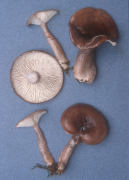
Lactarius pseudomucidus Smith & Hesler. Cap 4-10cm across, flatly convex becoming shallowly depressed to broadly funnel-shaped, with an inrolled margin that becomes wavy; dark charcoal brown; smooth and very slimy. Gills adnate to decurrent, close to subdistant, narrow to quite broad; white with a blue-gray tinge, spotting yellowish to brown in age. Stem 40-100 x 5-12mm, hollow, very fragile, enlarging toward base; dingy brown or gray on surface and paler within; very slimy when fresh. Flesh thin, limber; grayish. Latex thin, milk-white, changing very slowly, spotting gills yellowish to brown. Odor slight. Taste slowly, increasingly acrid. Spores broadly ellipsoid, amyloid, 7-9 x 6-7µ; ornamented with heavy bands with branches forming a virtually distinct reticulum, prominences 0.5-1.2µ, high. Deposit white. Habitat singly or gregarious under conifers. Common. Found widely distributed in the Pacific Northwest. Season August-October. Not edible. |